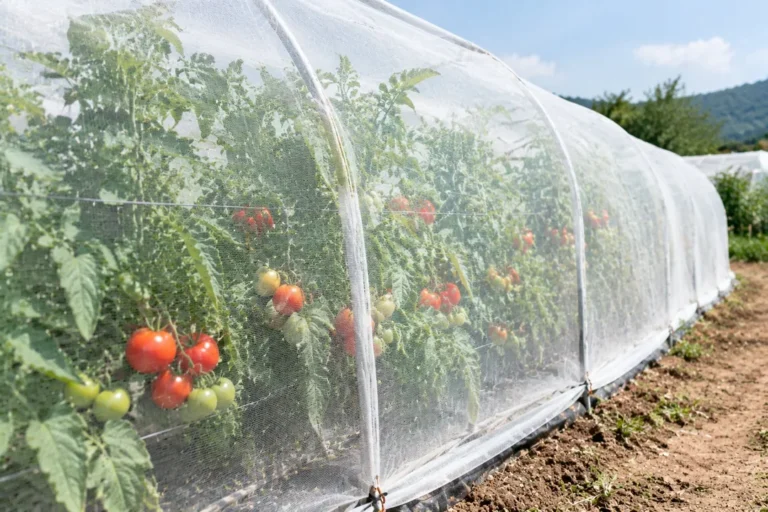
How Insect Netting Helps Protect Citrus Orchards
Insect netting gives citrus growers a physical barrier against selected flying pests — most importantly the Asian citrus psyllid, the vector of huanglongbing (citrus greening). But a net is only as good as its specification and installation. This guide explains what netting can and cannot do in a citrus orchard, and what to check before you cover a block.
The central principle is simple: match the clear aperture to the pest you need to exclude, and make sure your orchard can still breathe.
How does insect netting protect citrus orchards?
Insect netting protects citrus by creating a physical barrier between trees and selected flying pests. When designed for the target insect and installed without gaps, it can reduce pest movement into a covered area or onto protected young trees. This may help reduce feeding damage and the risk of insect-vectored diseases.
Netting is a preventive tool, not a complete pest-control program. The results depend on the pest species, opening size, coverage, orchard layout and whether pests are already inside the barrier.
It can reduce access by specific insect pests
Citrus growers may use screens or covers to limit access by pests such as the Asian citrus psyllid, which can spread the bacterium associated with huanglongbing (citrus greening). Protective screen structures and individual protective covers are used in some citrus systems to keep psyllids away from trees, especially young trees.
Netting can also influence other pest populations, but performance varies by pest, mesh and orchard system. A study of permanent protective netting in South African citrus orchards monitored several pests, including citrus thrips, Mediterranean fruit fly, citrus mealybug and false codling moth. That evidence does not mean every net or installation will exclude every species.
It can protect young trees during establishment
Individual protective covers can isolate young citrus trees from psyllids while they establish. Whole-screen or row-cover systems can protect a larger planting area — the approach used in citrus under protective screen (CUPS) production, where trees are grown inside a screened structure from planting onward. The appropriate approach depends on farm scale, target pests, labor, equipment access and local growing conditions.
A cover must fit the intended tree size and be installed so insects cannot enter through openings at the top, bottom or seams. Check the tree periodically to ensure growth is not restricted and pests have not become trapped inside.
It supports an integrated pest management plan
By reducing the number of pests reaching covered trees, netting may reduce pressure on other control measures. It works best alongside clean planting material, monitoring, sanitation and locally recommended pest management. Continue scouting within protected areas: pests may enter before installation, arrive on plants or pass through openings that are too large.
For citrus greening and other regulated pests, follow local agricultural and quarantine guidance. Netting does not replace required reporting, testing or official disease-management measures.
It can help protect fruit, depending on the system
A net canopy or row cover may limit access by some fruit-feeding insects and can reduce exposure to certain physical hazards, depending on its design and the pest being targeted. Protection is not automatic: openings, timing, net position and the crop’s growth stage all matter. Select the system for the specific risk rather than assuming that any shade or insect net will protect fruit from all pests.
Which mesh size should you use in a citrus orchard?
For Asian citrus psyllid, growers commonly specify screens in the 40–50 mesh range, because the aim is to block an insect roughly 2–3 mm long while keeping enough air permeability for the canopy. Where citrus thrips or other very small insects are also a concern, a finer screen is usually needed — our guide to mesh size for thrips control explains why 80–100 mesh is the starting point for those pests.
In practice:
- 40 mesh — psyllid-oriented screening with the most open airflow
- 60 mesh — a balance between psyllid exclusion, airflow and general pest cover
- 80 mesh — where thrips and other tiny insects are the deciding factor
Do not select on mesh label alone. Thread diameter changes the real opening at the same mesh count, so ask for the clear aperture in millimeters or microns and confirm it against local extension or regulatory recommendations for your region.
What to consider before covering citrus trees
Choose mesh for the target pest. Ask for the clear opening dimensions, thread construction and test information for the pest you need to exclude. Mesh count alone does not describe the exact aperture, and products with the same mesh label can have different opening sizes. University of California guidance for Asian citrus psyllid barriers emphasizes balancing openings small enough to restrict psyllids with sufficient air permeability. Verify the recommended specification for your region and system.
Maintain airflow and orchard conditions. Screens can reduce airflow and alter temperature and humidity within a covered structure. These effects depend on mesh, porosity, screen area, structure design and local climate. Before covering an entire block, consider ventilation, heat load, water management and access for machinery. Monitor conditions after installation, especially during hot or humid periods.
Plan for flowering and pollinators. A net enclosure can limit pollinator access if it is closed during bloom. Plan how pollination will occur for the citrus variety and production system. Depending on the operation, timing, temporary access, managed pollinators or other locally appropriate measures may be needed. Discuss the plan with an orchard adviser before installation.
Keep beneficial insects and pest monitoring in mind. A barrier may restrict beneficial insects as well as pests. It may also change pest and predator populations inside the enclosure. Continue inspecting leaves, flush, flowers and fruit, and adapt the integrated pest management plan to the covered environment.
Seal and maintain the barrier. Inspect joins, doors, ground edges, vents and repair patches. Small tears or loose edges can create entry points. Clean accumulated dust or debris when needed, since clogged netting can further reduce airflow. Check the structure after wind or storms and make repairs promptly.
A practical planning checklist
Before choosing an orchard netting system, write down:
- Target pest or hazard and the evidence for the selected mesh
- Tree age, variety, row spacing and canopy dimensions
- Whether you need individual covers, row covers or whole-block screening
- Clear aperture, porosity and airflow information
- Pollination plan during bloom
- Ventilation, water and machinery-access requirements
- Fastening, sealing, inspection and repair plan
- Material, UV stabilization, expected service life and warranty
- Local extension or regulatory recommendations
If you are still comparing suppliers, the same criteria apply across crops — see our buying checklist for agricultural insect netting.
Protect citrus with the right netting plan
Insect netting can help protect citrus orchards by restricting access to selected pests, especially when the barrier is matched to the target insect and installed as a complete, maintainable system. Its effectiveness depends on mesh opening, orchard design, climate, pollination and ongoing monitoring.
CROPBASTION supplies UV-stabilized HDPE insect netting in 40–100 mesh options for crops, greenhouses and orchards, with custom widths. Share your target pest, tree or row dimensions, climate and installation plan when requesting a specification — request a free quote.
Sources and further reading
- UC IPM: Asian Citrus Psyllid in Citrus
- UF/IFAS: Citrus under Protective Screen (CUPS) Production Systems
- UF/IFAS: Individual Protective Covers for Young Citrus Trees
- The effect of permanent protective netting on insect pest prevalence in citrus orchards in South Africa — African Entomology
- CROPBASTION insect netting specifications