Which Insect Net Mesh Size Is Best for Thrips Control?
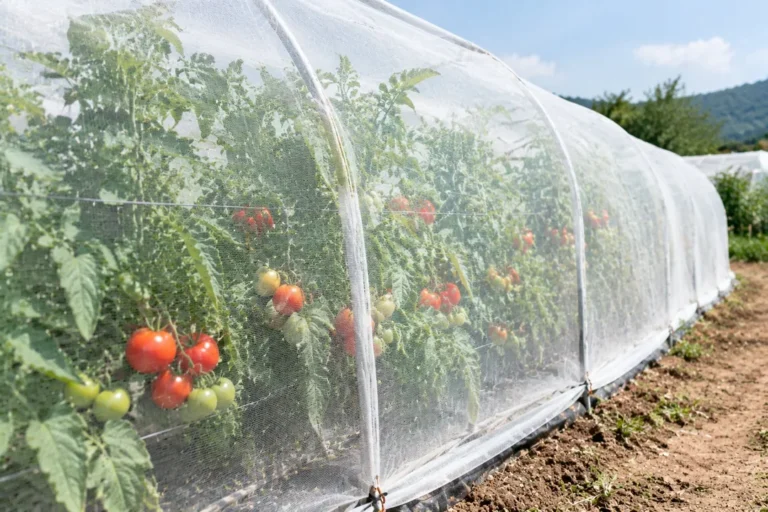
For greenhouse crops where thrips exclusion is a priority, start by evaluating a fine 80–100 mesh insect net. Choose based on the net’s measured aperture and construction, rather than mesh count alone. A finer screen can reduce airflow, so confirm that your greenhouse ventilation can handle it before covering large vents or sidewalls.
A 60-mesh net may be a practical compromise where airflow is a major concern, but it should not be treated as a guaranteed thrips barrier. A 40-mesh net generally offers less restrictive airflow and may help exclude larger insects, yet it is not the first choice when the goal is stronger protection from tiny thrips.
Why mesh count is only part of the answer
“Mesh” usually describes the number of threads or openings across a set distance. It does not, by itself, tell you the exact size of each opening. Thread diameter, weave pattern and the way the screen is manufactured all affect the clear aperture and porosity.
This matters because thrips are narrow-bodied and can sometimes pass through openings that appear small. Research comparing greenhouse screens found that exclusion differed between materials and could not be predicted from airflow resistance alone. A recent greenhouse study also cautions that the tested 40-, 60- and 80-mesh openings were not all smaller than thrips body dimensions, so complete physical exclusion should not be assumed.
When comparing suppliers, ask for:
- Clear aperture or pore dimensions in millimeters or microns
- Thread diameter, material and weave type
- Porosity or airflow data, if available
- Test information for the target thrips species
- UV stabilization, expected service life and warranty
Comparing 40, 60, 80 and 100 mesh
40 mesh — general screening: general insect screening with relatively open airflow. May help with larger pests; usually a less restrictive option, but not the strongest starting point for thrips exclusion.
60 mesh — mid-range: a possible airflow/exclusion compromise. Verify aperture dimensions and test performance for your target species.
80 mesh — fine screening: for smaller insects. A stronger candidate when reducing thrips entry is important. Check ventilation capacity and greenhouse climate.
100 mesh — very fine: consider where pest exclusion is the top priority and ventilation can be engineered for the added resistance. Monitor temperature, humidity and airflow.
These are comparison categories, not universal guarantees. Different products carrying the same mesh count can have different openings and airflow characteristics.
How to choose the right net for your greenhouse
1. Identify the pest and the entry route. Thrips may enter through vents, doors, damaged screens, gaps around frames or infested plant material. Screening helps most when outside insects are the main source. It will not remove thrips already present on plants or brought into the greenhouse on transplants.
2. Compare actual aperture dimensions. Ask the manufacturer for the clear opening measurement, not just the mesh label. If possible, compare the technical specification and a sample under magnification. The geometry and shape of the opening also affect whether insects can pass through.
3. Account for ventilation. Fine screens restrict airflow and can raise temperature or humidity if the ventilation system is not sized for the added resistance. Before installing fine mesh across all vents, review fan capacity, vent area, crop heat load and local climate. Increasing screened surface area or using a suitable ventilation design may help maintain airflow.
4. Install it as a complete barrier. Seal edges and joins, repair tears promptly, and keep doors closed or screened. A fine mesh with unsealed gaps can still allow pests inside. Inspect the screen regularly for dust buildup and physical damage.
5. Combine screening with integrated pest management. Start with clean planting material, inspect incoming plants, monitor flowers and growing points, and use sticky cards as part of a monitoring program. Remove weeds and plant debris that can host pests. Screening is one preventive layer, not a stand-alone treatment for an established infestation.
Which option should you choose?
Choose 80 mesh as a starting point when you need stronger thrips protection but still need to preserve ventilation.
Evaluate 100 mesh when exclusion is the top priority and your greenhouse can manage the additional airflow resistance.
Consider 60 mesh when ventilation constraints are significant, after confirming the aperture and accepting that protection may be less complete.
Use 40 mesh for broader screening needs where airflow matters more than fine thrips exclusion.
The best choice depends on the crop, climate, greenhouse design, pest species and net construction. Ask for aperture measurements and airflow information before ordering, and trial the screen on a representative vent or compartment when practical.
Need help selecting insect netting?
CROPBASTION supplies UV-stabilized HDPE insect netting in 40, 60, 80 and 100 mesh options, with custom widths. Share your target pest, crop, greenhouse dimensions and ventilation setup so the right specification can be discussed — request a free quote.
Sources
- Comparison of greenhouse screening materials for excluding whitefly and thrips — Journal of Economic Entomology
- Context-Dependent Suppression of Thrips by Insect-Proof Nets in Greenhouse Eggplant and Potato — Insects (2026)
- Exclusion Methods for Managing Greenhouse Vegetable Pests — UF/IFAS Extension
- Thrips management guidelines — Cornell Greenhouse Horticulture
2 Comments