A Complete Guide to Insect Nets: How to Choose and Use Them Correctly
Insect netting is a physical barrier tool that keeps pests away from crops by creating a screen over vents, doors, windows, and greenhouse perimeters. Unlike chemical pesticides, it cuts off pest invasion at the source, making it one of the key measures for pollution-free production in modern agriculture.
The Core Principle of Insect Nets
An insect net may look simple, but its function goes far beyond “keeping bugs out.” Its core value lies in creating an artificial isolation barrier that excludes pests from the crop area, dramatically reducing the need for chemical pesticides. This matters especially for export crops—many importing countries have strict limits on pesticide residues, making physical protection a practical way to meet plant protection regulations.
In addition, insect nets can block the spread of insect-borne viral diseases. Sucking pests such as aphids and whiteflies are vectors of plant viruses. Keeping them out effectively breaks the chain of viral transmission.
How to Choose Mesh Count: Start with the Pest You’re Targeting
“Mesh count” is the most common source of confusion when selecting insect nets. Mesh count is defined as the number of openings per linear inch (25.4 mm)—the higher the mesh count, the smaller the aperture.
But choosing a net shouldn’t start with mesh count. It should start with the target pest.
Different pests vary greatly in body size. Tiny pests like whiteflies and thrips require higher mesh counts for effective exclusion, while larger pests like cabbage worms and armyworms can be blocked with medium mesh counts. For example, the whitefly is roughly 0.2 mm in body width, and effective exclusion requires a mesh count of 74 or higher. For general flies and moths, 25 to 40 mesh is usually sufficient.
Thread diameter also matters. At the same mesh count, a thicker thread produces a smaller aperture and better pest exclusion—but also greater airflow resistance. So you can’t judge by mesh count alone; you need to consider thread diameter as well.
Balancing Pest Exclusion and Ventilation
A key trade-off with insect nets is this: the denser the net, the better the pest exclusion, but the worse the ventilation.
Studies show that a 60-mesh insect net can reduce ventilation by as much as 40%. In hot, humid regions, insufficient ventilation leads to rising temperatures and accumulating humidity inside the greenhouse, which actually increases disease risk. Data shows that insect nets with extremely low ventilation coefficients (Cd < 0.2) can cause greenhouse temperatures to rise by as much as 10°C under strong sunlight.
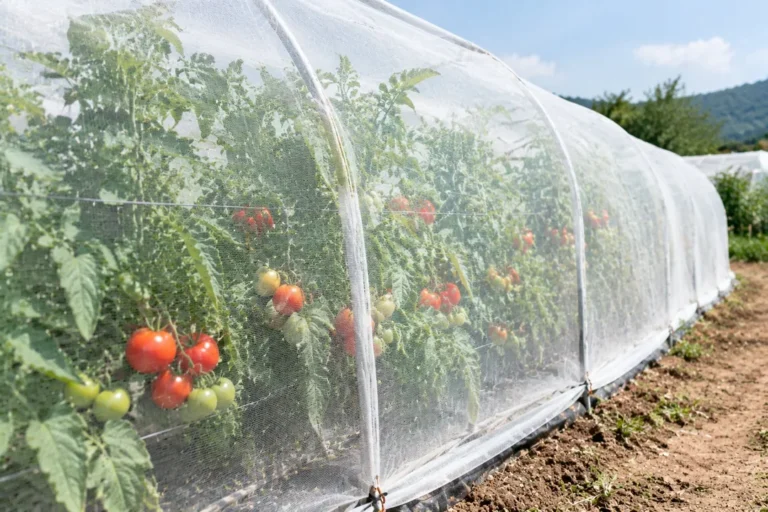
Therefore, in hot regions or on temperature-sensitive crops, choosing an overly fine net may require compensating with active ventilation equipment or larger vent areas. Tomatoes typically need 40 to 50 mesh to exclude whiteflies, but if thrips are also a major threat, 60 to 80 mesh may be necessary—and you must ensure the ventilation system can handle the airflow loss.
Material and Durability
Common insect net materials include polyethylene, polyester, nylon, and higher-end options like stainless steel and fluoropolymer fibers.
UV degradation is the main threat to insect net lifespan. Ordinary plastic nets gradually become brittle and tear under prolonged sun exposure. Quality insect nets incorporate UV stabilizers to extend service life. Fluoropolymer fibers (such as PVDF) have extremely low UV absorption and remain virtually unaffected after years of outdoor exposure, with lifespans of five to ten years or more. Ultra-fine stainless steel mesh is known for durability and fire resistance, and it is recyclable.
Color also affects performance. Black nets reduce reflected glare and offer better visual clarity; white or silver-gray nets lower greenhouse temperatures in summer; transparent nets have the highest light transmission but may create refractive glare.
Installation Essentials: Details Determine Success
The quality of installation often determines the final result more than the quality of the net itself.
Cover all entry points, not just vents. Pests can enter through doors, roll-up film gaps, fan openings, foundation cracks, and any other opening. Before installation, check every potential entry point one by one to create an “opening checklist.”
Ensure the net fits tightly against the frame with no gaps. The net and surrounding covering should be overlapped and secured tightly, lying flat without wrinkles. Perimeter netting should extend 0.5 to 1 meter down into the soil to prevent pests from entering from below.
Mind the smoothness of the frame. Sharp edges, rusted clips, or damaged frames can tear the net, causing early failure and repair issues. Fix these defects before installation.
Consider daily operational needs. Even with perfect vent protection, pest exclusion fails if doors are left open or people move through freely. Entry doors should have automatic closing curtains or buffer zones.
Supporting Measures: Insect Nets Are Not a Silver Bullet
The effectiveness of insect nets depends on correct usage. Before planting, thoroughly clear weeds and plant debris inside the greenhouse to reduce the pest population base. Soil treatment and high-temperature solarization can kill soil-borne pests and pathogens. After netting is installed, crops that rely on insect pollination need to switch to hand pollination or bumblebee pollination.
Regularly inspect the net, repair tears promptly, and clean accumulated dust to maintain light transmission. After seasonal use, wash and dry the net and store it away from light to extend its lifespan.
Summary: The first step in choosing an insect net isn’t browsing a catalog—it’s walking into the field and observing: what are your main pests, where do they come from, and can your greenhouse ventilation design handle the extra airflow resistance? The right insect net is the balance point you find between pest exclusion, ventilation needs, and climate conditions.